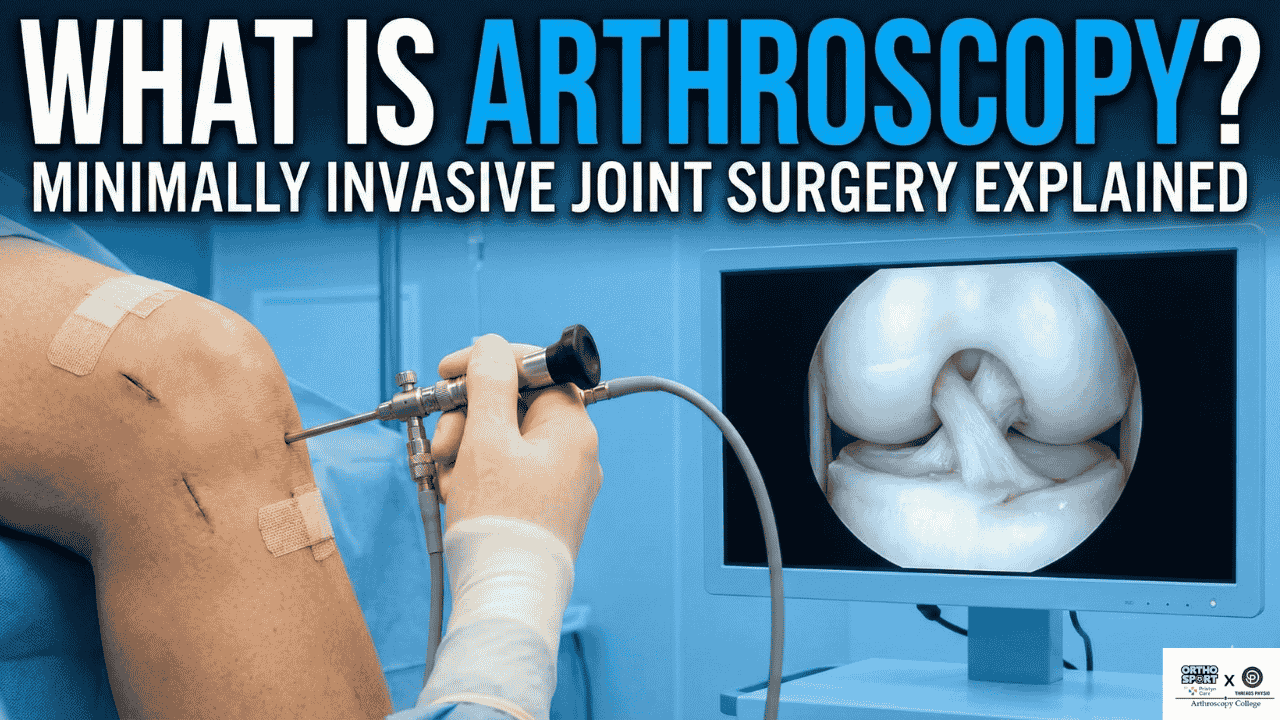
Have you ever wondered how doctors can see inside your knee or shoulder without making a big cut? It sounds like magic, but it’s actually a super cool medical technology called Arthroscopy.
Imagine playing a video game where you use a tiny camera to explore a hidden cave. That is exactly what an orthopaedic surgeon (a bone doctor) does! They use a tiny camera to look inside your joints, find the problem, and fix it.
At Arthroscopy College, we are experts in this amazing technology. In this guide, we will explain everything you need to know about arthroscopy in simple words that even a 5th grader can understand.
What Exactly Is Arthroscopy? (The “Keyhole” Camera)
The word Arthroscopy (pronounced: ahr-THROS-kuh-pee) comes from two Greek words:
- “Arthro” (meaning Joint)
- “Skopein” (meaning To Look)
So, it literally means “to look inside the joint.”
In the past, if you had a knee problem, doctors had to make a large cut to see what was wrong. That hurt a lot and took a long time to heal. Today, doctors use a special tool called an arthroscope.
Think of the arthroscope as a pencil-thin tube with a tiny fiber-optic camera and a light on the end. The doctor makes a tiny cut—about the size of a buttonhole—and slides this camera inside. The camera sends live video to a big TV screen, letting the doctor see your cartilage, ligaments, and bones in super high definition!
Did You Know? Because the cuts are so small, this is often called “Keyhole Surgery” or “Minimally Invasive Surgery.”
Why Do Doctors Do It? (Finding & Fixing)
Doctors use arthroscopy for two main reasons:
- To Diagnose (Find the Problem): Sometimes, X-rays and MRI scans don’t show everything. An arthroscopy lets the doctor see exactly what is causing your pain, stiffness, or swelling.
- To Treat (Fix the Problem): Once they see the problem, they don’t just leave it there! They can insert tiny superhero tools (like miniature scissors or shavers) through another small hole to repair tears, remove loose bone, or stitch up ligaments.
Which Joints Can Be Treated? (Knee, Shoulder & More)
While doctors can look inside almost any joint, they use arthroscopy most often for the joints that move a lot.
- The Knee: This is the most common one! It’s used to fix torn meniscus (cartilage) or ACL injuries.
- The Shoulder: Great for fixing rotator cuff tears or disconnected shoulders.
- The Hip: Helps with hip pain and extra bone growth.
- The Ankle: Used for ankle pain after sprains or fractures.
- The Elbow & Wrist: For treating stiff joints or removing loose bits of bone.
At Arthroscopy College, we specialize in teaching these advanced techniques to help patients recover faster.
Common Problems Fixed by Arthroscopy
Your joints are like hinges that help you move. Sometimes, parts of these hinges break or get inflamed. Here is what arthroscopy can fix:
- Torn Ligaments: Like the ACL in your knee (common in soccer players!).
- Torn Cartilage: The meniscus in the knee or the labrum in the shoulder.
- Loose Bodies: Tiny chips of bone or cartilage that float around and get stuck (like a pebble in your shoe).
- Inflammation (Synovitis): When the lining of the joint gets swollen and angry.
- Carpal Tunnel Syndrome: Pressure on the nerve in your wrist.
- Rotator Cuff Tears: When the muscles that help lift your arm get ripped.
Do you think you might have one of these issues?
How to Get Ready (Preparation)
Getting ready for arthroscopy is easy, but you have to follow the rules!
- Tell Your Doctor: List all the medicines you take. You might need to stop some of them (like blood thinners) a few days before.
- The “NPO” Rule: This stands for “Nothing by Mouth.” usually, you cannot eat or drink anything after midnight the night before surgery. This keeps you safe while you sleep during the surgery.
- Dress comfortably: Wear loose clothes (like gym shorts) that are easy to put on later.
- Get a Ride: You won’t be allowed to drive home, so ask a friend or family member to pick you up.
Step-by-Step: What Happens During the Surgery?
It might sound scary, but it is actually very organized. Here is what happens:
- Anesthesia: The doctor gives you medicine so you don’t feel any pain. You might be asleep (General Anesthesia) or just numb in that area (Local/Regional Anesthesia).
- The Incision: The surgeon makes a tiny cut (about 4mm small!).
- The Water: They pump sterile fluid (saltwater) into the joint. This expands the joint like a balloon so the doctor has room to see and work.
- The Camera: The arthroscope goes in. The doctor watches the TV screen to explore.
- The Repair: If something is broken, they make another tiny cut to insert small tools to fix it.
- The Finish: The water is drained, and the cuts are closed with one or two small stitches or sticky tape.
Watch Dr. Manu Bora explain how this works in 3D:
Arthroscopic ACL Reconstruction { 3D Animation } in Hindi
This video shows the incredible “inside view” of a knee surgery using these tiny tools.
Arthroscopy vs. Open Surgery: The Big Difference
Why is arthroscopy so popular? Let’s compare it to the old-fashioned “Open Surgery.”
| Feature | Arthroscopy (Keyhole) | Open Surgery (Traditional) |
| Incision Size | Tiny (Buttonhole size) | Large (Several inches) |
| Pain | Less pain | More pain |
| Hospital Stay | Go home same day | Stay in hospital for days |
| Recovery | Fast (Weeks) | Slow (Months) |
| Scarring | Almost invisible | Big scar |
Risks and Safety (Is it Dangerous?)
Arthroscopy is very safe! Complications are rare (happening in less than 1% of cases). However, like any surgery, there are small risks:
- Infection: Germs getting into the cut.
- Blood Clots: Rarely, blood can clump in the leg veins.
- Swelling or Bleeding: The joint might be puffy for a few days.
Recovery: Getting Back to Action
The best part about arthroscopy is how fast you heal! You can usually go home an hour or two after surgery.
To heal quickly, remember R.I.C.E. for the first few days:
- Rest: Take it easy.
- Ice: Put ice packs on the joint to stop swelling.
- Compress: Wrap it with a bandage.
- Elevate: Keep the joint raised up on a pillow.
Important: You must do your Physiotherapy exercises. This helps your muscles get strong again. Most people can go back to school or desk work in a few days, and back to sports in a few weeks or months, depending on the surgery.
See how we train experts to do this perfectly:
Dr. Manu Bora teaching the next generation of surgeons exactly how to perform these advanced repairs.
A Quick History Lesson (Who Invented It?)
Did you know arthroscopy started over 100 years ago?
- 1912: A doctor named Severin Nordentoft was the first to write about looking inside a knee.
- 1960s: A Japanese doctor named Masaki Watanabe (the “Father of Arthroscopy”) improved the camera so much that doctors could finally see clearly.
- 1970s: Dr. Robert Jackson brought these techniques to the Western world, saving the careers of many famous athletes!
Why Choose Arthroscopy College?
At Arthroscopy College, led by the renowned Dr. Manu Bora, we use the most advanced technology available, like the “All-Inside Internal Brace” technique. This allows for:
- Faster Recovery: Walk the next day!
- No Pain: Advanced pain management.
- World-Class Training: We train surgeons from all over the world.
Check out our Gallery to see our success stories!
Frequently Asked Questions (FAQs)
1. Is arthroscopy painful?
Most patients feel very little pain compared to open surgery. You will have anesthesia during the surgery so you won’t feel anything. Afterward, simple medicine usually handles any soreness.
2. How long does the surgery take?
It is very fast! Most procedures take between 30 minutes to 2 hours.
3. Can I walk after knee arthroscopy?
In many cases, yes! You might need crutches for a few days, but Dr. Manu Bora’s advanced techniques often allow patients to walk immediately.
4. Is it expensive?
Arthroscopy saves money because you don’t have to stay in the hospital overnight.