Hey there!
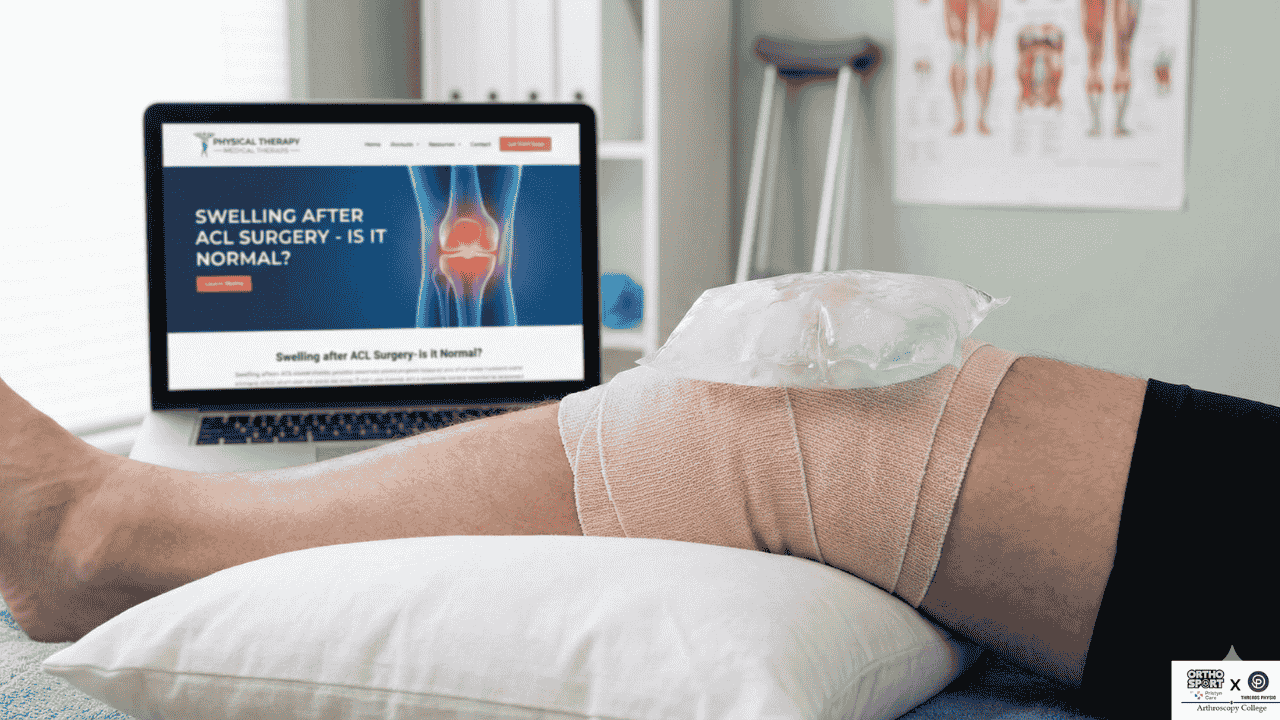
Did you just have knee surgery? Or maybe you are getting ready for it?
First, don’t panic. If your knee looks like a big, puffy balloon right now, you are in the right place.
My name is Dr. Manu Bora, and today I am going to talk to you like a friend. I know seeing your knee swollen can be scary. You might think, “Did something go wrong?” or “Will it stay like this forever?”
The short answer is: Swelling is normal. It is actually your body’s way of fixing itself!
But, there are times when you should call your doctor. In this easy guide, I will tell you exactly why your knee swells, how long it lasts, and 8 bad signs you must watch out for.
Let’s get your knee back to normal!
1. What is ACL Surgery? (A Quick Look)
Imagine your knee has four strong ropes holding it together. The ACL (Anterior Cruciate Ligament) is one of the most important ropes in the middle.
If you play sports like football or basketball, you might twist your knee and “pop” this rope. Ouch!
ACL surgery is when a doctor (like me!) goes in and fixes that rope using a new piece of tissue (called a graft). It helps you run, jump, and play again. But right after surgery, your knee needs time to heal.
Did You Know? We use a tiny camera called an arthroscope to see inside your knee. This means we don’t have to make big cuts! Check out our Gallery to see how we do it!
2. Why Does My Knee Swell?
Think of swelling like a construction crew rushing to a broken road.
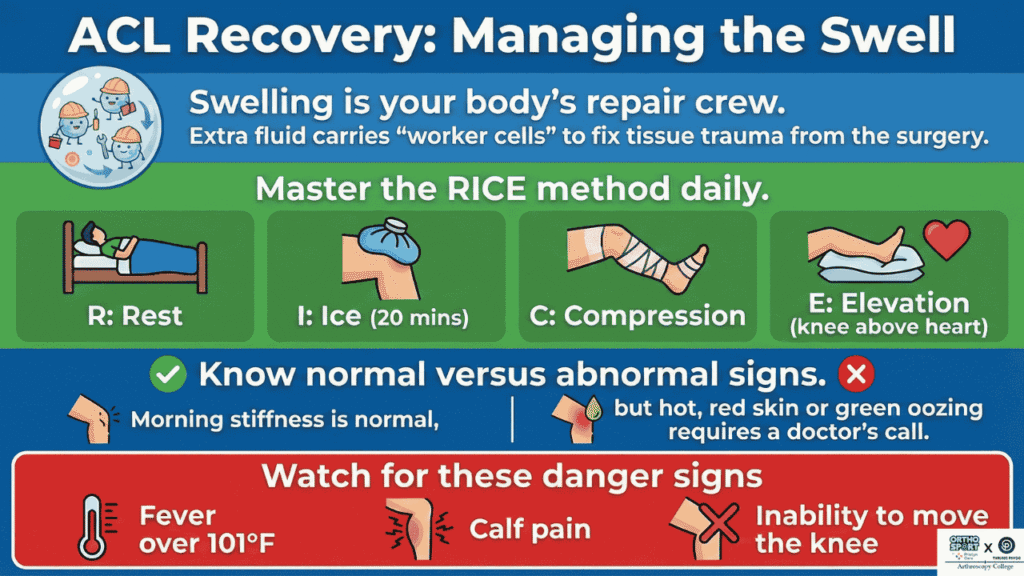
When you have surgery, your body sends extra blood and fluid to the knee. This fluid carries “worker cells” to fix the cut tissues.
Here are the 3 main reasons for the puffiness:
- Tissue Trauma: Even though surgery is helpful, it is still a “trauma” to your body. Your knee reacts by getting inflamed.
- Fluid Buildup: Your body sends extra fluid to protect the area. It’s like a cushion.
- Not Moving Enough: Since you are resting, your muscles aren’t pumping the old fluid out. It just sits there!
3. The Swelling Timeline: What to Expect
Recovery is a journey. Here is a simple map of what your knee might look like:
Week 1-2: The “Balloon” Phase
- What happens: Your knee will be very swollen. It might feel tight and warm.
- Action: Rest, Ice, and keep your leg up high!
- Pain: You might need medicine. This is the hardest part.
Week 3-6: The “Calming Down” Phase
- What happens: The big swelling goes down. You might still see a little puffiness above the kneecap.
- Action: You start walking more (maybe without crutches!).
- Note: If you walk too much, it might swell up again. That’s okay. Just rest a bit.
Month 2-3: The “Looking Good” Phase
- What happens: Your knee looks almost normal!
- Action: You are doing more exercises.
Warning: Sometimes, after a hard workout, it might get a tiny bit swollen. This is just your knee saying, “Hey, I’m still healing!”
4. Is My Swelling Normal? (The “Yes” vs. “No” List)
It’s hard to tell if you are okay or not. Use this simple checklist:
| NORMAL (Good Signs) | ABNORMAL (Call Doctor) |
| Swelling goes down after icing. | Swelling gets bigger after Week 2. |
| Knee feels stiff in the morning. | Knee is hot, red, and angry. |
| Mild pain that medicine helps. | Sharp pain that medicine can’t fix. |
| Bruising (yellow or purple). | Yellow or green oozing from the cut. |
5. 8 Bad Signs You Must Not Ignore
Sometimes, swelling means something is wrong. If you see these signs, call us immediately.
- Excessive Swelling: It suddenly gets huge again after going down.
- Unbearable Pain: You are crying in pain, and pills don’t help.
- Redness & Heat: The skin around the cut is bright red and burning hot. (Could be an infection).
- Stuck Knee: You physically cannot bend or straighten it at all, even a little bit.
- Weird Noises: A little “click” is okay. A loud, painful “CRACK” is not.
- Fever: Your body temperature goes over 101°F (38.5°C). You feel shivering or chills.
- Blood Clots (DVT): This is dangerous! Look for sharp pain, redness, or swelling in your calf muscle (back of your lower leg).
- Instability: You feel like your knee is going to give out or buckle when you stand.
Need a Quick Opinion? Don’t guess. Send us a message now. Chat on WhatsApp with Dr. Manu Bora
6. How to Reduce Swelling Fast (The RICE Method)
Want to make that balloon go down? Follow the RICE rule!
- R – REST: Don’t run a marathon! Give your knee a break. Use crutches if your doctor said so.
- I – ICE: Ice is your best friend. Put an ice pack on your knee for 20 minutes, 4 or 5 times a day. (Don’t put ice directly on the skin; use a towel!).
- C – COMPRESSION: Wear an elastic bandage or a special knee sleeve. It hugs your knee and pushes the fluid away.
- E – ELEVATION: This is the most important one! Lie down and put pillows under your heel. Your knee must be higher than your heart. This uses gravity to drain the fluid back into your body.
7. Best Exercises to Pump Fluid Out
Moving your leg gently acts like a pump. It pushes the old, swollen fluid out. Here are 3 easy moves you can do in bed.
(Always ask your physiotherapist before starting!)
1. Ankle Pumps
- Lie on your back.
- Move your foot up and down like you are pressing a gas pedal.
- Do this 10 times every hour.
2. Heel Slides
- Lie on your back.
- Slowly slide your heel toward your butt, bending your knee just a little.
- Slide it back down.
- Don’t force it if it hurts!
3. Quad Sets
- Lie with your leg straight.
- Tighten the muscle on top of your thigh (Quadriceps).
- Push the back of your knee into the bed.
- Hold for 5 seconds, then relax.
8. Mental Recovery: Don’t Give Up!
Healing is not just about your body. It is about your mind, too.
It is normal to feel frustrated or sad when you can’t walk fast. You might miss playing sports. This is temporary.
- Set Small Goals: “Today, I will do my ankle pumps.”
- Celebrate Wins: “Yay! I bent my knee a little more today!”
- Stay Connected: Talk to friends or join our support group.
See a Real Recovery Story:
Watch how this patient got back to sports in just a few months!
9. Frequently Asked Questions (FAQs)
Q: Can I travel 3 months after surgery?
A: Usually, yes! But you must stretch your legs often so you don’t get stiff.
Q: Why does my knee click?
A: It might be scar tissue breaking up or fluid moving. If it doesn’t hurt, it is usually okay.
Q: What if I have a lump on my thigh?
A: Very rarely, fluid can get trapped and form a cyst. If you feel a hard lump, show it to your doctor.
Q: When can I play sports again?
A: Most people go back to sports in 6 to 9 months. Don’t rush, or you might hurt it again!
Need Help? Let’s Talk!
At Arthroscopy College, we teach the best ways to heal knees. Dr. Manu Bora is an expert in making sure you recover fast and safe.
Do not wait if you are in pain.
- 📞 Call Us Now: +91 93101 38022
- 💬 Book a Free Consultation
- 🎓 Learn More: Check our Fellowship Details
Stay strong. Your comeback starts now!