Have you ever wondered how doctors fix a knee or shoulder problem without making a huge cut? The answer is a super-cool technology called arthroscopy.
If your doctor mentioned this word and you are feeling a bit nervous or confused, don’t worry! We are going to explain it simply just like we would explain it to a 5th grader. By the end of this guide, you will know exactly what is happening inside your joint.At Arthroscopy College, we believe understanding your body is the first step to healing. Let’s dive in!
What Is Arthroscopy? (The Simple Definition)
Let’s start with the basics. The arthroscopy definition is actually hidden in the name itself. It comes from two Greek words:
- “Arthro” means joint (like your knee or shoulder).
- “Scopy” means to look.
So, put them together, and arthroscopy simply means “to look inside a joint.”
It is a procedure where a doctor uses a tiny camera to peek inside your body. Instead of cutting the skin wide open like in old-fashioned surgeries, they only make a tiny hole—about the size of a buttonhole. Because the cuts are so small, many people call it “keyhole surgery” or minimally invasive surgery.
Think of it like this: If you lost a toy under the sofa, you wouldn’t cut the whole sofa open to find it, right? You would shine a flashlight and use a stick to get it out. Arthroscopy is exactly like that for your joints!
How Does Arthroscopy Work? (The “Camera” Magic)
Okay, so how do they actually see inside?
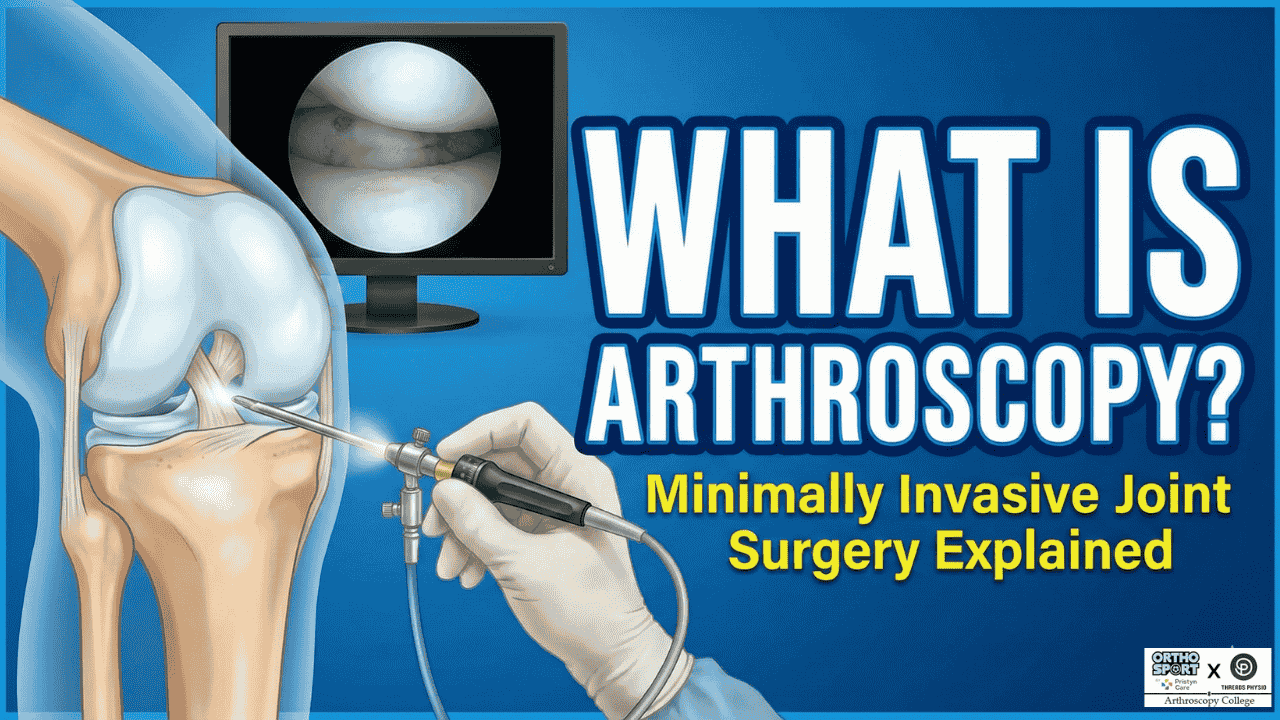
Surgeons use a special tool called an arthroscope. This is a long, thin tube (about the width of a pencil) with a tiny camera and light on the end.
Here is the magic trick:
- The camera sends live video to a TV screen in the operating room.
- The doctor watches the TV screen to see inside your knee, shoulder, or ankle in high definition.
- Because the camera magnifies everything (makes it look bigger), the doctor can see cartilage tears or damage much better than they could with just their naked eyes.
The “Dime” Size Difference
In normal surgery, a doctor might make a cut that is 3 or 4 inches long. In arthroscopy, the cut is tiny—about the size of a dime. This is why it hurts less and heals so much faster!
Types of Arthroscopy: Which Joints Can We Fix?
Doctors can use this camera trick on almost any big joint in your body. The knee arthroscopy definition is simply using this camera specifically for the knee joint, which is the most common one.
Here are the main joints doctors can fix:
- Knee: For torn ligaments (like the ACL) or meniscus tears.
- Shoulder: For rotator cuff tears or if your shoulder keeps popping out.
- Ankle: For pain after a sprain or loose bone chips.
- Hip: For hip pain that won’t go away.
- Elbow: For tennis elbow or stiffness.
Wrist: For carpal tunnel or wrist pain.
Arthroscopy vs. Open Surgery: Why “Small” Is Better
If you look up the arthroscopy medical definition, you will see doctors love it because it is “minimally invasive.” But what does that mean for you?
Comparing Arthroscopy to Open Surgery is like comparing a scratch to a big cut.
| Feature | Open Surgery (Old Way) | Arthroscopy (New Way) |
| Cut Size | Big (inches long) | Tiny (buttonhole size) |
| Pain | More pain | Less pain |
| Hospital Stay | Often stay overnight | Go home the same day |
| Recovery | Months | Weeks |
| Scars | Large scar | Tiny, barely visible dots |
Because the doctor doesn’t have to cut through a lot of muscle to get to the joint, your body stays stronger.
Preparing for Your Surgery: Getting Ready
Even though it is a small surgery, it is still surgery! Here is how you get ready:
- No Eating: Your stomach usually needs to be empty. Your doctor will tell you when to stop eating (usually the night before).
- Medications: You might need to stop taking certain medicines that thin your blood.
- The Ride Home: You cannot drive after surgery because of the anesthesia (sleeping medicine). Make sure a friend or family member is there to drive you!
What Happens During the Surgery? (Step-by-Step)
This is the cool part. If you were awake (though you usually aren’t!), here is what you would see happening in the operating room:
- Sleepy Time: You get anesthesia so you don’t feel anything. You might be totally asleep (General) or just numb from the waist down (Local/Regional).
- The Tiny Cut: The surgeon makes a small incision (less than half an inch).
- Water Works: The doctor pumps sterile salt water (saline) into your joint. This expands the joint like a balloon, giving the camera plenty of room to see.
- Action!: The camera goes in. The doctor looks at the TV screen to find the problem.
- The Fix: If they find a tear, they make another tiny hole to insert small tools—like miniature scissors or shavers—to fix it.
- Closing Up: The water is drained, and the tiny cuts are closed with a stitch or special tape. Bandages go on, and you are done!
Recovery: Getting Back to Action
The best part about arthroscopy is how fast you get back to your life.
- Going Home: Most people go home the same day.
- R.I.C.E Method: To stop swelling, remember Rest, Ice, Compression (bandage), and Elevation (prop it up on pillows).
- Crutches: If it was your knee or ankle, you might need crutches for a few days.
- Physical Therapy: This is super important! You will do special exercises to make your muscles strong again.
Check out our Fellowship in Physiotherapy to see how experts learn to help patients recover!
Are There Risks? (Is It Safe?)
Arthroscopy is very safe, but like any surgery, there are small risks. These are rare (they don’t happen often):
- Infection: Bacteria getting into the cut.
- Blood Clots: Thick blood in the leg veins.
- Swelling: Sometimes the joint stays puffy for a while.
Your doctor will give you instructions to prevent all of these!
Why Choose Arthroscopy College?
At Arthroscopy College, led by Dr. Manu Bora, we specialize in the most advanced, high-tech treatments. Whether you are a patient looking for relief or a student looking for a Fellowship in Arthroscopy, we are the leaders in the field.
We don’t just fix joints; we help you get your life back.
Ready to Fix Your Pain?
Call Us Now: 919310138022
People Also Ask (FAQs)
Q: Is arthroscopy painful?
A: It is much less painful than regular surgery. You will feel some soreness for a few days, but medicine and ice help a lot.
Q: Can I walk after knee arthroscopy?
A: Often, yes! Many patients can walk (sometimes with crutches) the same day. But always listen to your doctor.
Q: How long does the surgery take?
A: Usually between 30 minutes and 2 hours, depending on what needs to be fixed.
Q: What is the main purpose of arthroscopy?
A: To diagnose (find) and treat (fix) joint problems using a camera without making large cuts.