
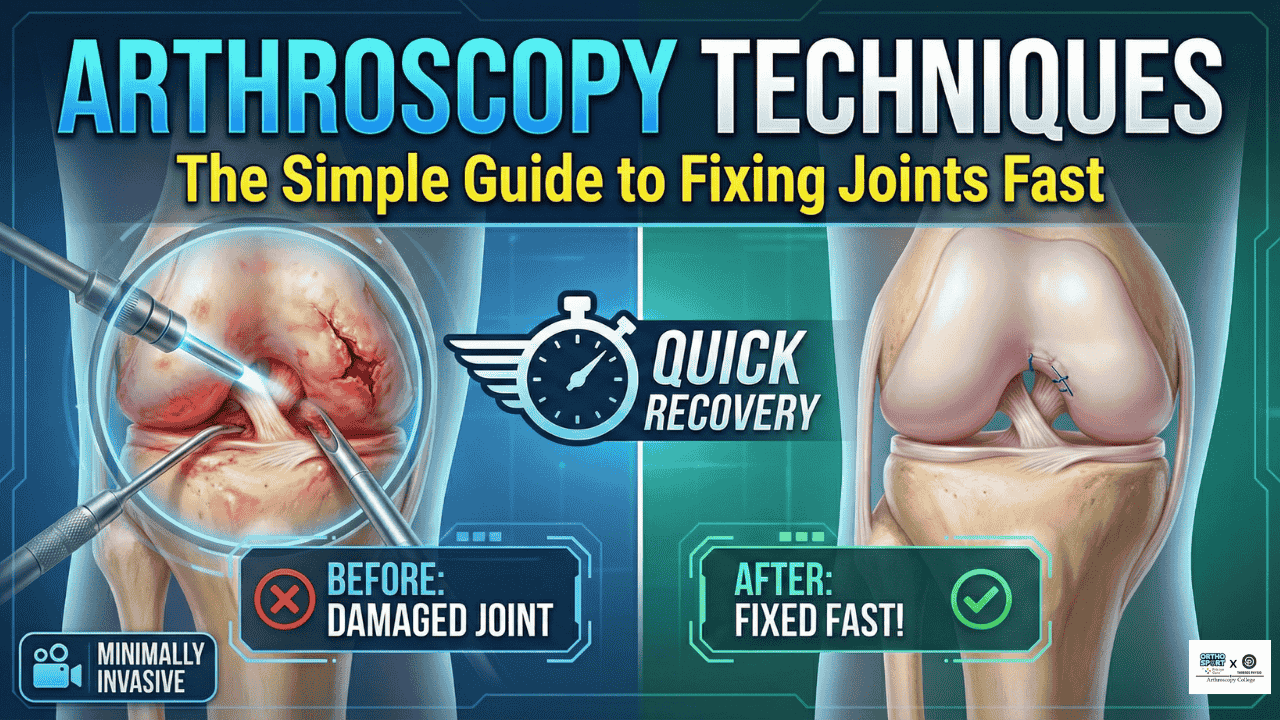
Are you or a loved one dealing with knee pain that just won’t go away? Maybe your shoulder clicks every time you lift your arm? You might have heard your doctor say a big, scary word: Arthroscopy.
Don’t worry! It sounds complicated, but it is actually a superhero way to fix joints without making big cuts. Imagine fixing a ship inside a bottle that is exactly what Arthroscopy is!
At Arthroscopy College, led by the expert Dr. Manu Bora, we specialize in the most advanced versions of this surgery. We want to get you back to running, playing sports, or just walking pain-free as soon as possible.In this guide, we will break down everything you need to know about arthroscopy techniques in simple words. No confusing medical talk just the facts you need.
What is Arthroscopy? (The “Keyhole” Magic)
Arthroscopy (say it like Ar-thros-copy) is a procedure for diagnosing and treating joint problems.
Think of it like this:
- “Arthro” means Joint.
- “Scopy” means to Look.
So, it literally means “to look inside the joint.”
In the old days, doctors had to cut your knee wide open to see what was wrong. Ouch! Today, using arthroscopy techniques, doctors make a tiny cut about the size of a buttonhole. They insert a tiny camera called an Arthroscope. This camera sends live video to a TV screen, letting the doctor see inside your body and fix the problem using tiny tools.
Why is this better?
- Less Pain: Smaller cuts mean less hurting.
- Faster Healing: You go home the same day or the next day!
- Tiny Scars: Almost invisible marks.
Why Do You Need Arthroscopy?
Your joints are like the hinges on a door. Over time, or because of a sports injury, these hinges can get rusty or broken. You might need arthroscopy if you have:
- Loose Bone Fragments: Tiny pieces of bone floating in your knee or elbow.
- Torn Ligaments: Like the famous ACL tear in the knee (common in footballers!).
- Damaged Cartilage: The soft cushion between bones wears out.
- Inflammation: The lining of your joint gets swollen and angry.
Did You Know? Dr. Manu Bora uses special Fellowship-level techniques to fix these issues without opening the whole joint!
Common Types of Arthroscopy Techniques
Arthroscopy isn’t just for knees. It can be used all over the body!
1. Knee Arthroscopy (The Most Common)
This is used mostly for ACL Injuries and Meniscus Tears.
- ACL Reconstruction: Fixing the main stabilizer of the knee.
- Meniscus Repair: Sewing up the torn cushion in your knee.
Watch Dr. Manu Bora Explain Advanced ACL Surgery
2. Shoulder Arthroscopy
Used for Rotator Cuff Tears or Dislocated Shoulders.
- If you can’t lift your arm without pain, this might be for you.
- We fix the tendons so your shoulder stays in its socket.
3. Hip, Ankle, and Wrist Arthroscopy
These are less common but super effective for deep pain that X-rays might miss.
The Procedure: Step-by-Step (What Happens?)
If you are getting surgery at Arthroscopy College, here is exactly what happens. It is not as scary as you think!
- Anesthesia: You will be given medicine so you don’t feel any pain. You might be asleep or just numb.
- The Portal (The Tiny Cut): The surgeon makes a small cut (about 4mm to 5mm).
- Insert the Camera: The arthroscope goes in. Saline water is pumped in to expand the joint so the doctor can see clearly.
- The Fix: Using another tiny cut, the surgeon inserts special tools (like mini scissors or shavers) to repair the damage.
- Closure: The cuts are so small they often need just one stitch or a simple bandage!
Advanced Techniques: Why Dr. Manu Bora is Different
This is the most important part. Not all arthroscopy is the same. Dr. Manu Bora uses Next-Gen 2026 Techniques that many other doctors don’t use yet.
1. All-Inside ACL Reconstruction with Fiber Tape Internal Brace
This is a game-changer.
- Traditional Surgery: Uses screws that can hurt later. Recovery takes months.
- Dr. Bora’s Technique: Uses a “Fiber Tape” (like a seatbelt for your ligament).
- Result: You can walk without support the very next day!
- Pain: Much less than traditional screws.
- Return to Sports: Faster and safer.
2. Knotless Suture Anchors
In shoulder surgery, old techniques used big knots that could irritate your skin. We use knotless anchors that bury into the bone, leaving a smooth surface.
Check out our Gallery to see real success stories!
Recovery: How Fast Can I Move?
Because arthroscopy techniques are minimally invasive, recovery is super fast.
- Day 1: You can usually stand and walk (with our Internal Brace technique).
- Week 1: Basic exercises begin.
- Month 1-3: You are back to light jogging and gym work.
- Month 6: Most athletes return to professional sports!
We also offer specialized Fellowships in Physiotherapy to ensure our rehab protocols are world-class.
Risks and Complications (Being Honest)
Every surgery has some risk, but with arthroscopy, they are very low.
- Infection: Rare (less than 1%).
- Blood Clots: We give you meds to prevent this.
- Swelling: Normal for a few days.
Note: Choosing an experienced surgeon like Dr. Manu Bora drastically reduces these risks.
Frequently Asked Questions (People Also Ask)
Q: Is arthroscopy painful?
A: Most patients report very little pain compared to open surgery. You might feel soreness for a few days, which is easily managed with medicine.
Q: Can I walk immediately after ACL surgery?
A: Yes! With Dr. Manu Bora’s Internal Brace technique, most patients walk without crutches within 24 hours.
Q: How much does it cost?
A: It depends on the specific injury. However, arthroscopy is often cheaper in the long run because you spend less time in the hospital and get back to work faster.
Q: Do you offer training for doctors?
A: Yes! We run a premier Fellowship Program where we teach these advanced skills to other surgeons.
Conclusion: Ready to Live Pain-Free?
You don’t have to live with joint pain. Modern arthroscopy techniques have made fixing knees and shoulders easier, faster, and safer than ever before.
At Arthroscopy College, we combine cutting-edge technology (like the Fiber Tape Internal Brace) with compassionate care to get you back on your feet.
Don’t wait until it gets worse.


